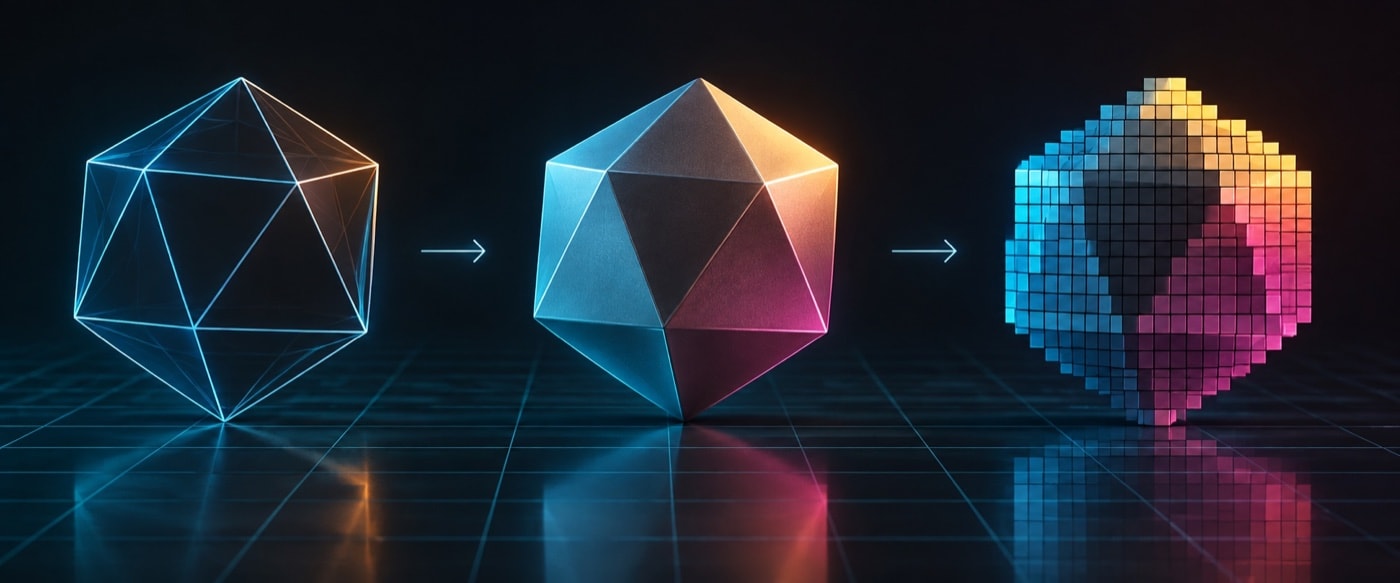
Pre-rendered does not mean automatic
A rendered source model can create complex lighting, material and volume, but a fighting game still needs individual frames that communicate action. The production challenge is therefore selective. Animators pose and light the source, render a sequence, choose frames, reduce them for the target hardware and clean the result so motion remains coherent at play speed.
Every stage changes the image. A smooth model becomes a set of discrete poses. Fine surface detail becomes clusters of pixels. Subtle movement may disappear, while a strongly exaggerated pose can survive. The final craft lies in knowing what to preserve.
Model and material
The source form establishes silhouette, surface and the way light travels across the body.
Pose and render
Key actions are staged for clarity, with anticipation, contact and recovery visible as separate moments.
Reduce and select
Frames are resized and timed for the game, forcing choices about which details remain useful.
Clean and integrate
Edges, shadows and color are adjusted so the figure reads against animated backgrounds.
Silhouette survives compression
The cast’s extreme variety is practical as well as expressive. A low creature, a broad boxer, a skeletal swordsman, a liquid alien and an angular machine remain distinct after detail is reduced. Silhouette carries identity when texture cannot.
This is why the cast guide begins with material and shape. Visual difference is the first layer of matchup readability. It tells the player who occupies the screen before any technical data is considered.
Background motion without losing the plane
The games use moving, rendered environments to create depth, but combat still depends on a stable two-dimensional relationship. Background movement can make a stage feel cinematic so long as it does not obscure distance, contact or corner position. The art direction must keep spectacle behind information.
That same priority governs effects. Fire, ice, sparks and impact flashes make attacks distinctive, but their duration and brightness must support the state change rather than cover it. Read the sound-design page for the parallel audio problem.
A reference without republishing art
This page explains a production method through original abstract illustration. It does not present character frames, gallery images or animation sheets. The method is the subject: how a dimensional source becomes a readable sequence under hardware limits.